

The official job description of a Chief Executive is deceptively mechanical: set the strategy, assemble the team, and raise the capital.
These functions—along with org design, metrics, hiring, and firing are quantifiable, teachable, and ultimately, the easiest parts of the job.
The invisible mandate, the one that actually dictates the enterprise's survival, is far more complex.
The true job description of a CEO is to serve as the chief psychologist of one: yourself.
You are required to stay clearheaded and functional while operating continuously under extreme, asymmetrical uncertainty.
The brutal twist of this hidden role is that you are simultaneously the therapist and the patient. No one else can do this work for you because no one else sees the full board or absorbs the full weight of its implications. Because you learn to be a CEO only by being a CEO, you are always executing this critical psychological work while underqualified and underprepared.
As an ecosystem architect, I no longer view the CEO simply as a leader; I see the CEO as the central biological processor of an exponential system.
When the processor overheats, the system fails.
To prevent systemic collapse, the executive mind must master three specific calibration protocols:
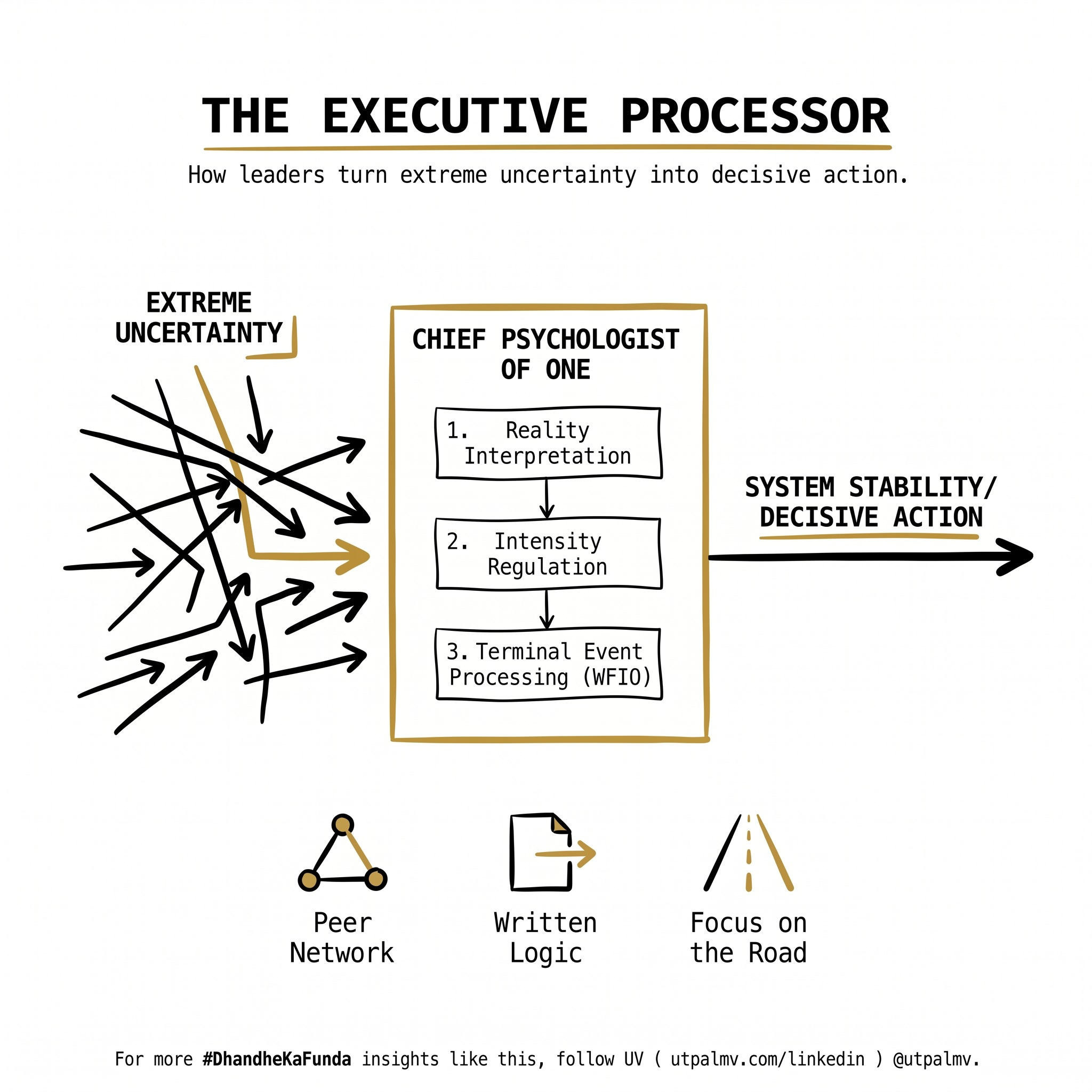
1. Reality Interpretation (Positional Objectivity):
You must strip away the ego to interpret reality accurately. This means not processing every localized failure or problem as a personal indictment, while simultaneously refusing to minimize genuine, existential threats.
2. Intensity Regulation (Managing the Throttle):
The objective is to sustain high-urgency momentum without crossing the threshold into systemic damage. You must stay urgent without terrorizing your team or burning out your own cognitive processor.
3. Terminal Event Processing (The WFIO Protocol):
Every operator will face “We’re F#%ked, It’s Over” (WFIO) anomalies. The mind will inevitably generate catastrophic signals. The skill is in holding these moments in isolation without letting them dictate your kinetic behavior or contaminate the broader organization.
The tools required to execute this are not philosophical; they are strictly operational. They give the concept of the “inner psychologist” actual operational teeth:
Externalize the Madness: Integrate with a peer group of other CEOs to normalize the psychological chaos.
Force Logic Over Fear: Ruthlessly write your decisions down to separate objective logic from emotional noise.
Calculate, Don’t React: Deliberately aim your cognitive bandwidth at what you want to create—focusing your attention on the road, not the wall.
The highest leverage action you can take for your company is not a new product feature. It is ensuring the system’s central processor remains cold, calculating, and ruthlessly objective.
~~~
For more #DhandheKaFunda insights like this // The UV Almanac